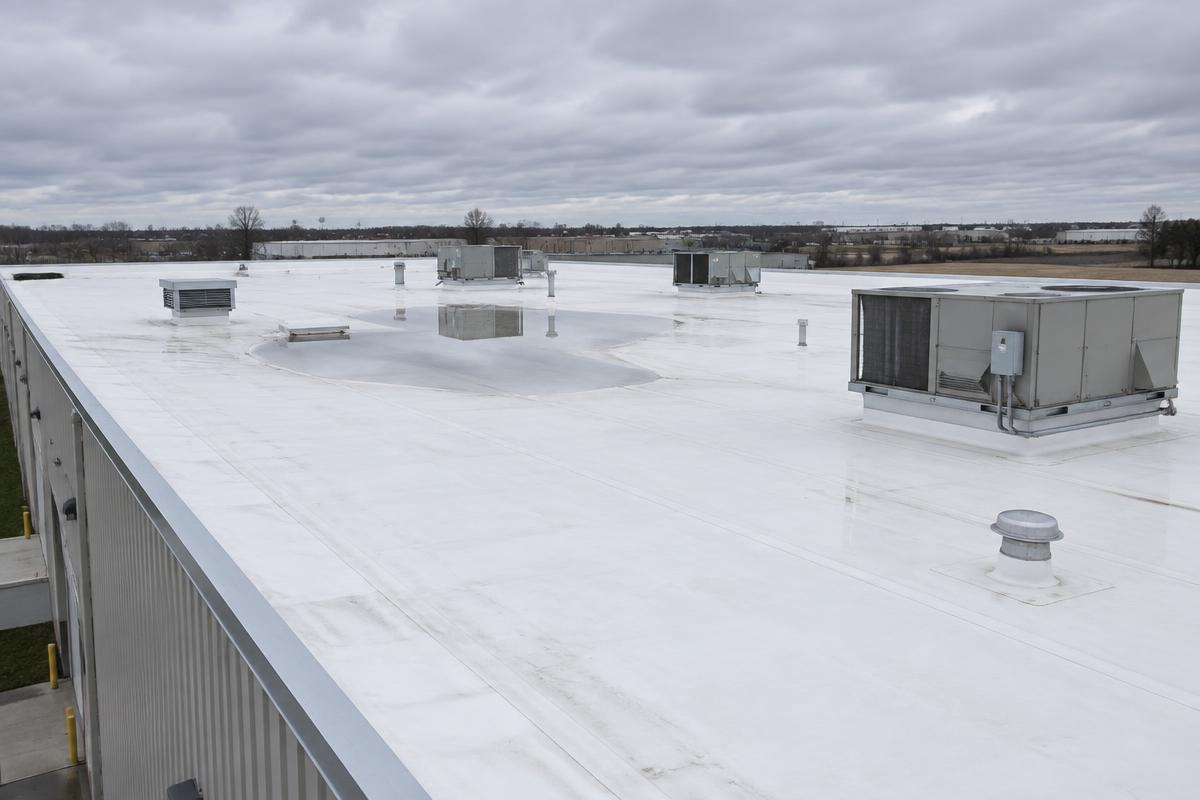
Strengths
- Heat-welded seams
- Reflective white surface
- Many thickness options
Watch for
Poorly welded seams, punctures from foot traffic, and flashing failures at curbs.
What TPO is and how it is installed
TPO (thermoplastic polyolefin) is a single-ply membrane, most often white or light gray, installed in large rolled sheets over insulation board. Seams between sheets are heat-welded with hot air, which fuses the material so the seam becomes part of the membrane rather than relying on adhesive or tape alone. Panels can be mechanically fastened, fully adhered, or ballasted depending on the building and roof design.
TPO versus EPDM versus modified bitumen
These three low-slope options solve the same problem in different ways. TPO offers a reflective white surface and heat-welded seams but depends heavily on weld quality. EPDM (see EPDM roofing) is a black rubber membrane known for flexibility in cold weather and easy patching, but its seams rely on adhesive or tape that can fail over time. Modified bitumen (see modified bitumen) is a multi-layer asphalt-based system that handles foot traffic and punctures well but needs careful lap and seam work during install. None of the three is universally better; the right choice depends on the building, budget, and how the roof will be used.
Where TPO seams and details tend to fail
- Field or shop welds that were not fully fused, which can open slowly over years
- Flashing at curbs, pipes, and parapet walls where detail work is harder than the open field
- Foot traffic punctures near rooftop equipment that gets serviced often
- Membrane shrinkage pulling at the perimeter on some older or lower-quality TPO products
Maintenance that extends TPO life
Keeping drains and scuppers clear so water does not pond, scheduling periodic seam and flashing inspections, and limiting unprotected foot traffic near HVAC units all help a TPO roof reach its full service life. A roof coating can sometimes extend a sound, aging TPO membrane, though it is not a fix for existing leaks or wet insulation.
Lifespan factors, loosely
TPO membranes often run in the range of 15 to 25 years depending on membrane thickness, weld quality, roof traffic, and UV exposure. Thicker membranes (measured in mils) generally hold up longer, and a well-welded install from day one matters more to long-term performance than most owners expect.
What an inspection on a TPO roof checks
A commercial roofing inspection on TPO typically probes seam integrity with a seam probe, checks flashing at every curb and penetration, looks for membrane shrinkage pulling away from walls or edges, and checks drains for standing water that points to a slope or clog problem.
Installation details worth asking about
Ask what membrane thickness is being used, whether seams are robot-welded or hand-welded (robot welds tend to be more consistent), how insulation is attached, and what warranty the manufacturer offers for that specific install method. These details affect both performance and price more than the base membrane color or brand name.
What good TPO workmanship looks like
A well-installed TPO roof has clean, consistent heat-welded seams with no wrinkles or fishmouths, properly terminated edges at the roof perimeter, flashing boots and pipe collars fully welded rather than just caulked, and insulation boards that are flat and fastened securely so the membrane lays smooth over them. A roofer who tests seams with a probe during a final walkthrough, rather than just a visual check, is taking the detail seriously.
Signs of poor TPO workmanship
- Visible wrinkles or fishmouths in the membrane where it was not laid flat
- Seams that lift or peel back with light hand pressure
- Caulk or mastic used in place of a proper weld at flashing details
- Ponding water pooling in the field rather than draining to scuppers or drains
- Membrane cut too short at the perimeter with exposed, unsealed edges
A worked decision example
Suppose a commercial building has a TPO roof with one failed seam near an HVAC curb causing a slow drip, but the rest of the field looks tight with no ponding. A targeted seam repair and flashing rework at that curb is usually the right scope. If instead several seams across different parts of the roof are lifting and a moisture survey finds wet insulation in multiple spots, that points toward a larger repair or planning for replacement, since isolated patches will not address a membrane that is failing broadly.
Seasonal timing for TPO work in central Illinois
Heat welding performs best in moderate, dry conditions, so many TPO projects are scheduled outside of the coldest winter stretches when welds are harder to control and outside of wet periods when moisture under the membrane is a bigger risk. Spring and fall tend to offer the most workable weather windows, though a leak that needs attention should not wait for ideal conditions.
Homeowner and property manager maintenance checklist
- Walk the roof (or have it walked) after major storms to check drains and scuppers for debris
- Keep rooftop equipment access paths clear so technicians are not stepping on unprotected membrane
- Note any new ponding areas and how long they take to drain
- Schedule a seam and flashing inspection on a regular cycle, not only after a leak appears
- Keep a record of past repairs and inspection findings to track how the membrane is aging
Mistakes to avoid with a TPO roof
Common mistakes include delaying a seam repair because the leak seems minor, allowing standing water to sit for long periods without checking drains, letting rooftop equipment technicians walk the membrane without protection boards, and applying a reflective coating over a membrane with unresolved wet insulation, which traps the problem rather than solving it.
Common questions
What color is a TPO roof?
Most TPO is white or light gray, which reflects sun. Other colors exist but are less common.
How are TPO seams joined?
TPO seams are usually heat-welded with hot air, which makes the seam part of the membrane.
Why is TPO usually white instead of other colors?
White and light gray TPO reflects more sunlight, which reduces heat gain inside the building. Other colors are made but are less common and can cost more.
Can a damaged TPO seam be re-welded instead of replaced?
Often yes. A clean, properly prepped re-weld over a failed seam section is a standard repair method rather than a full membrane replacement.
Does hail damage TPO the same way it dents metal?
Hail can bruise or puncture TPO rather than just denting it cosmetically, so hail impacts on membrane roofs are usually checked for actual punctures, not just surface marks.
Is ponding water always a problem on a TPO roof?
Brief ponding after rain is common on many low-slope roofs, but water standing for more than a day or two stresses seams and can signal a drainage or slope issue worth checking, related to [flat roof ponding](problems/flat-roof-ponding).
Can TPO be installed over an existing membrane?
Sometimes a recover is possible if the existing roof is dry and sound, but wet insulation or a failing membrane usually needs to be removed first.
What does a seam probe test actually involve?
A roofer runs a blunt probe tool along the seam edge to check whether it is fully bonded. A probe that catches or lifts the seam indicates an incomplete weld that needs repair.
Can TPO be repaired in cold weather if a leak shows up in winter?
Emergency repairs can often be made with specialized cold-weather techniques or temporary measures, but a full, properly welded repair is generally easier to achieve in milder conditions.
How often should a commercial TPO roof be professionally inspected?
Many property managers schedule at least one inspection a year plus a check after any major storm, though buildings with heavy rooftop equipment traffic may benefit from more frequent looks.
Commercial Roof Evaluation for Your TPO Membrane
Describe it in the form and a local roofing partner will help you sort it out.