Protect your warranty
If your roof has a manufacturer warranty, check who is allowed to repair it.
Membrane and system type
Commercial low-slope roofs are built from different systems, including TPO, EPDM, modified bitumen, and metal. Each has its own repair method, from heat-welding TPO seams to patching EPDM with specific adhesives, so the repair technique and the materials needed change depending on what system is already on the building.
Roof size and the scale of commercial work
Commercial roofs are often many times larger than a typical house roof, so even a localized repair may require more material staging, more time to access the specific trouble spot, and more coordination with building operations than a residential visit.
Wet or saturated insulation
When water gets under a commercial membrane, the insulation underneath can become saturated. Wet insulation does not dry out on its own and has to be cut out and replaced, or the repair will not hold. This is one of the most common reasons a seemingly small leak turns into a larger repair scope once the roof is opened up.
Access: lifts, ladders, and roof hatches
Getting crews and materials safely onto a commercial roof can require a ladder, a roof hatch, or in some cases a lift or crane for taller buildings. Access requirements add setup time and sometimes equipment rental cost that would not apply to a simple residential ladder access.
Rooftop equipment and curb flashing
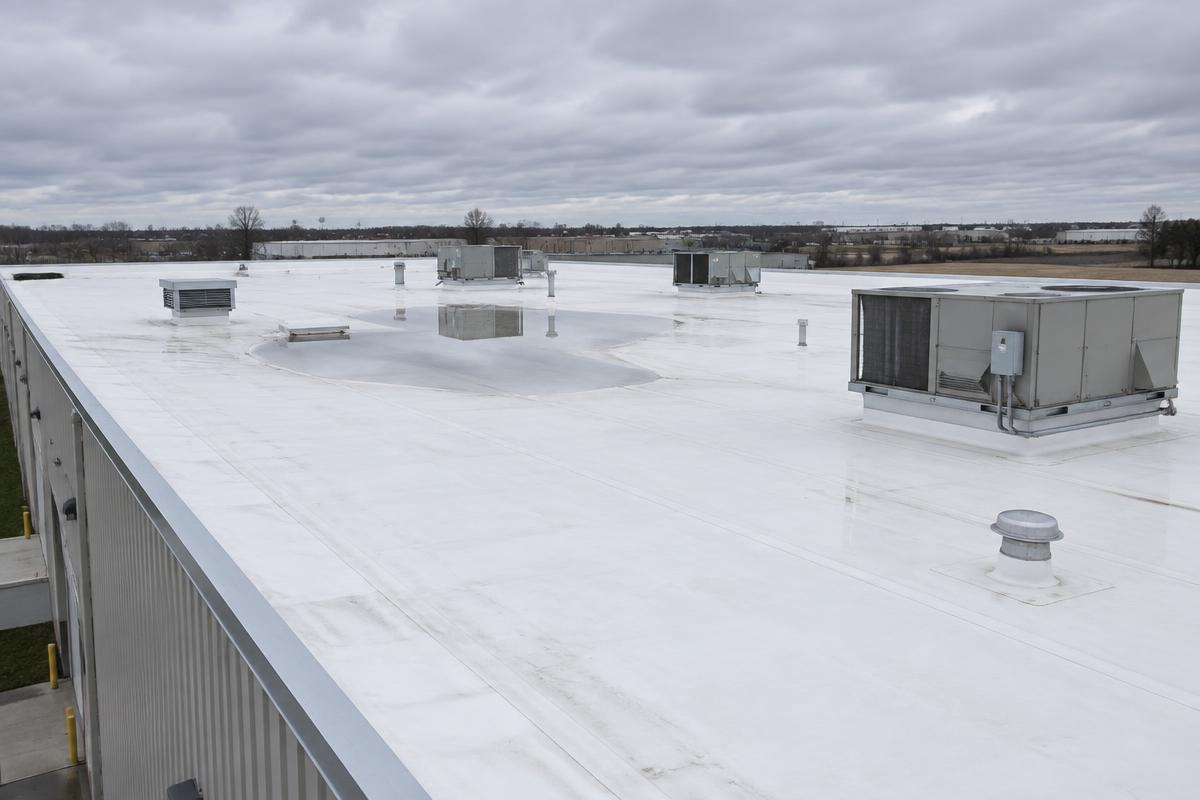
HVAC units, exhaust fans, and other rooftop equipment sit on curbs that need careful flashing to stay watertight. Repairs near this equipment take more care than open field membrane because the flashing has to tie into the curb correctly, and in some cases equipment may need temporary shutdown or relocation to access the area.
Drains, scuppers, and ponding areas
Flat and low-slope commercial roofs rely on drains and scuppers to move water off the roof. Repairs near these areas, or in zones with chronic ponding water, may need extra attention to slope and drainage, not just a patch, or the same leak is likely to return.
Manufacturer warranty rules
Many commercial membranes carry a manufacturer warranty that requires repairs to be performed by an approved contractor using approved materials and methods. Using the wrong patch material or an unapproved installer can void coverage, so it is worth confirming warranty status and requirements before any repair work begins.
Access scheduling around business operations
Unlike a vacant residential roof, commercial repairs often need to work around business hours, deliveries, tenant schedules, or sensitive operations inside the building. Coordinating repair timing to minimize disruption can affect how a job is scheduled, though it does not usually change the repair technique itself.
Insurance scope differences for commercial claims
Commercial roof insurance claims often involve a different scope than a typical residential claim. Policies may distinguish between storm damage and long-term wear, and larger roofs can trigger a more detailed inspection process with the insurer, sometimes including infrared moisture scans to document wet insulation before a scope of work is finalized. See our insurance claim process guide for how documentation generally works, and discuss with your agent how your specific commercial policy handles roof damage.
Should you get a moisture survey first?
On larger or older commercial roofs, a moisture survey can identify how much insulation is wet before committing to a repair-only or full-replacement plan. This is especially useful when leaks have been intermittent or hard to pinpoint, since the wet area under the membrane does not always line up with where water shows up inside the building.
How to compare commercial repair bids
A thorough commercial repair bid identifies the membrane type, the exact repair location and method, whether a moisture survey was performed, how wet insulation will be handled if found, and whether the work meets manufacturer warranty requirements for your specific roof system.
- Membrane type and compatible repair method
- Scope: patch area versus broader membrane condition
- Wet insulation plan and how it is verified
- Access method and any equipment needed
- Manufacturer warranty compliance
- Scheduling around building operations
The commercial repair process
A typical sequence runs from an initial call, to an on-roof inspection, to a written scope of work, to scheduling that accounts for building operations, to the repair itself, cleanup, and a final walkthrough with photo documentation. On larger properties, the inspection and scoping stage often takes longer than the repair itself, especially if a moisture survey is involved.
Weather and seasonal factors for commercial roofs
Large, low-slope commercial roofs are especially sensitive to ponding after heavy rain and to membrane stress from Central Illinois temperature swings and freeze-thaw cycles. Scheduling repairs before winter sets in can prevent small membrane issues from being made worse by ice and repeated freezing of trapped moisture.
When a repair signals a bigger decision
If the same section of a commercial roof keeps needing repairs, or if a moisture survey finds widespread wet insulation, it may be time to compare ongoing repair costs against a planned commercial roofing replacement rather than continuing to patch the same area.
Commercial cost drivers
| Factor | Why it matters |
|---|---|
| System type | TPO, EPDM, mod-bit, and metal repair differently |
| Wet insulation | Must be cut out and replaced |
| Access | Lifts, ladders, and roof hatches |
| Rooftop units | Curbs need careful re-flashing |
| Warranty rules | Manufacturer-approved repairs may be required |
Common questions
What makes commercial repairs cost more?
Roof access, wet insulation, rooftop equipment, and membrane type are big drivers.
Should I get a moisture survey first?
On larger roofs, knowing how much insulation is wet helps you decide between repair and replacement.
Does the type of commercial membrane change how a leak is repaired?
Yes, each membrane type uses a different repair method, such as heat-welding for TPO or specific adhesives and primers for EPDM, so the system on your roof affects both technique and materials used.
Why would a small commercial leak turn into a bigger repair once work starts?
Water often spreads under the membrane before it shows up inside the building, so wet insulation found during the repair may need to be cut out and replaced beyond the original leak point.
Can repairs be scheduled around our business hours?
In many cases yes, especially for repairs that do not require shutting down rooftop equipment, though scheduling depends on the scope of work.
What happens if a repair is done with the wrong material for our membrane?
It can both fail to seal properly and potentially void the manufacturer's warranty on the rest of the roof, which is why confirming compatible materials matters.
Is a moisture survey always necessary for a commercial repair?
Not always, but it is often worthwhile on larger or older roofs where the extent of wet insulation is not obvious from the surface.
Request a Commercial Roof Evaluation
Describe it in the form and a local roofing partner will help you sort it out.