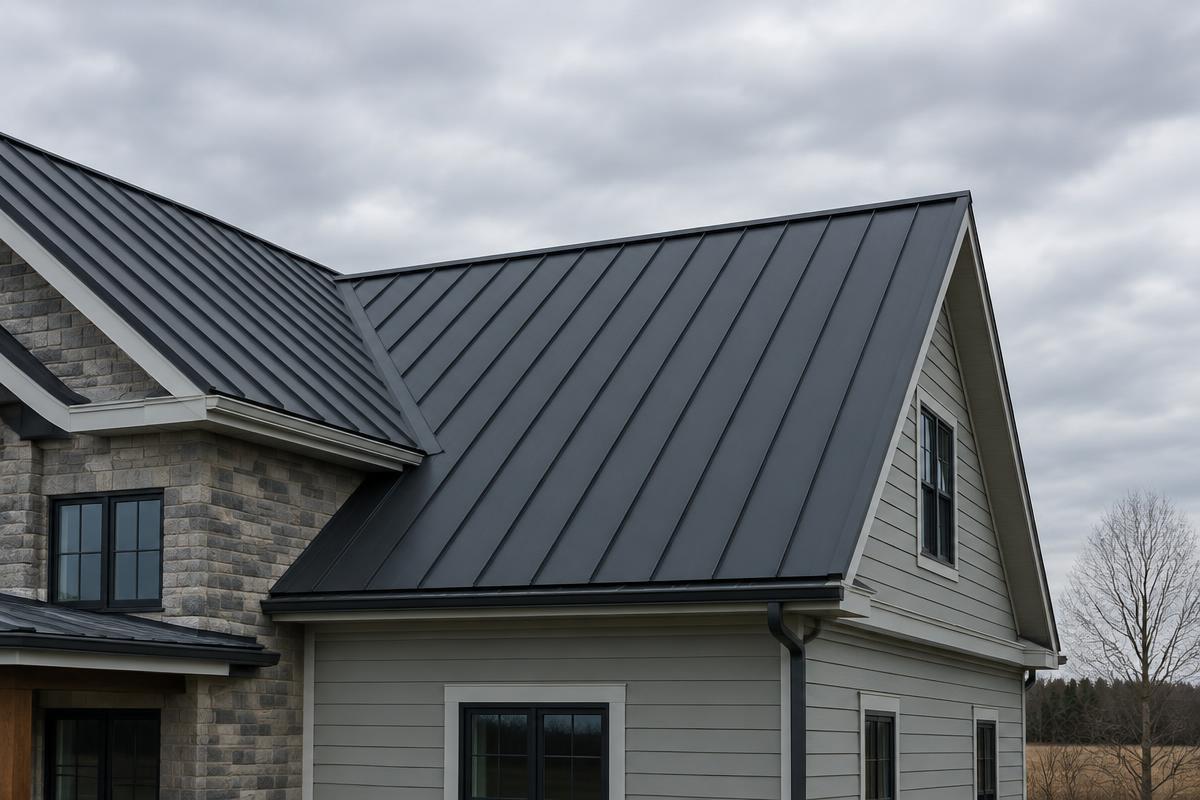
Where it fits
Pole barns, machine sheds, garages, and budget-focused homes. It installs fast and costs less than standing seam.
The upkeep reality
Rubber washers under each screw age in sun. Over time screws loosen as metal expands and contracts. Plan for periodic screw checks and replacement.
How exposed-fastener panels are built
Exposed-fastener metal, often called ag panel or screw-down metal, is installed with screws driven directly through the panel face into the purlins or decking below. Each screw carries a rubber or neoprene washer meant to seal the hole. That washer, not the metal itself, is usually the first thing to wear out.
Exposed fastener versus standing seam
The core difference is where the fasteners live. Standing seam panels (covered at standing seam metal roofing) use hidden clips under raised seams, so nothing pierces the visible panel and the metal can expand and contract freely with temperature. Exposed-fastener panels cost less and install faster, but every screw is a potential leak point and the fixed fasteners fight the metal's natural movement, which is part of why washers and screw holes wear over time.
Where this roofing makes the most sense
- Pole barns, machine sheds, and agricultural buildings
- Detached garages and workshops
- Budget-conscious home re-roofs where upfront cost matters most
- Buildings where a fast install matters more than a seamless look
The maintenance reality owners should expect
Rubber washers harden and crack in sun and heat over the years, and screws can back out or loosen as the panel expands and contracts through hot summers and cold winters. Many owners have screws checked every few years and replace any that are backed out, stripped, or showing a cracked washer. Left unchecked, a handful of failed fasteners can lead to roof leaking after heavy rain that is hard to trace from inside.
What fails first on this roof type
In order of how often it shows up: washer seals dry out and crack, screws back out from thermal cycling, panel laps and ridge trim loosen, and in hail-prone stretches the panels can show cosmetic dents without being punctured, see hail dents for how that is usually assessed. Rust at cut edges or scratches in the coating is another common early issue if panels were field-cut without sealing the edge.
Installation details that matter
Panel overlap, screw spacing, and torque all affect how well the roof performs. Over-driven screws crush the washer and stop sealing; under-driven screws leave a gap. Panels should also be fastened into solid framing, not just decking, with layout planned so water always flows over a lap, not into one.
Lifespan, loosely estimated
Exposed-fastener metal roofs often run somewhere in the range of 20 to 40 years depending on coating quality, climate exposure, and how consistently the fasteners are maintained. Galvanized panels generally wear faster than painted or Galvalume-coated panels. Treat any number as a rough range, since upkeep habits matter as much as the material itself.
What an inspection on this roof checks
A roofer walking an exposed-fastener roof typically checks for backed-out or stripped screws, cracked or missing washers, rust bleeding from cut edges or screw holes, loose ridge and trim pieces, and any panel lifting at the eave where wind uplift is strongest.
What good exposed-fastener workmanship looks like
A well-installed panel roof has consistent screw spacing in a straight line down each rib, screws driven flush so the washer seats evenly without crushing, panels overlapped in the correct direction so water always flows over a lap rather than into one, and trim pieces at ridges, eaves, and gables fastened snugly with no visible gaps. Cut edges should be sealed or at least painted to slow rust, and chalk lines or snapped guides should be visible in how straight the screw rows run.
Signs of poor workmanship on a panel roof
- Wandering, uneven screw lines instead of straight rows down each rib
- Crushed washers from over-driven screws, which stop sealing almost immediately
- Panels overlapped the wrong direction relative to water flow
- Unsealed cut edges left bare, inviting early rust
- Trim and flashing pieces that look loosely fastened or gapped at corners
A worked decision example
Picture a pole barn roof where a handful of screws near the eave have backed out and two washers are visibly cracked, but the panels themselves show no rust-through or denting. In that case, a straightforward fastener service call, replacing the worn screws and washers, usually resolves the issue without touching the panels. Compare that to a roof with rust streaking from multiple cut edges and several loose ridge pieces across the whole building; that pattern suggests a broader maintenance visit or partial panel replacement is worth discussing rather than a single spot fix.
Seasonal timing considerations in central Illinois
Metal panel work can generally happen in a wider temperature range than shingle work since there is no sealant strip that needs warm weather to bond, but ice on a metal surface makes walking the roof unsafe, so winter fastener checks are often scheduled for milder stretches. Many owners plan a maintenance check in spring after winter freeze-thaw cycling and again before the fall and winter season begins.
Homeowner maintenance checklist for panel roofs
- Walk the building perimeter after storms looking for lifted panel edges or debris caught at the eave
- Check accessible screws periodically for backing out, stripping, or cracked washers
- Clear leaves and debris from valleys and gutters so water does not pool against panel laps
- Watch for rust streaks running down from screw heads or cut edges
- Schedule a fastener and seam check every few years even if no leak has appeared
Questions to ask before fastener or panel work
- Will all fasteners be checked, or only the ones near the reported issue
- What screw and washer type will be used for the replacement, and is it rated for this panel
- If a panel needs replacing, can it be color-matched closely enough
- How will the roofer confirm no additional panels are compromised
- What is the plan if hidden rust is found once a panel is lifted
Common questions
How often do exposed-fastener screws need attention?
The rubber washers age in sun and heat. Many owners have screws checked every few years and replace backed-out or cracked ones.
Is exposed-fastener metal OK on a house?
Some homes use it, but it is more common on barns, shops, and garages. Movement at the screws is the main thing to plan for.
Can individual screws be replaced without redoing the whole roof?
Yes, in most cases. Failed screws can usually be backed out and replaced with a slightly larger screw and fresh washer, as part of routine upkeep rather than a full reroof.
Is it bad to walk on an exposed-fastener metal roof?
Walking directly on the panel flats between ribs, with care and soft-soled shoes, is usually fine on solid panels, but walking on weakened or rusted sections can cause new leaks or dents.
How do I know if a panel needs replacing instead of patching?
Widespread rust-through, multiple punctures in one panel, or significant denting from storm impact usually points to replacement. Isolated washer or fastener issues are typically repairable.
Does paint color affect how long exposed-fastener metal lasts?
Painted and Galvalume-coated panels generally resist corrosion better than plain galvanized panels, which can affect how long the roof holds up before rust becomes an issue.
Can exposed-fastener metal be installed over an old roof?
Sometimes it can go over wood shakes or certain decking with purlins, but this depends on local code and structural capacity. Ask the roofer to confirm what applies to your building.
Why do screws on a metal building roof seem to loosen faster near the eaves and ridge?
Those areas see the most wind uplift and the sharpest temperature swings as the panel edge moves more than the field, which puts extra stress on the fasteners located there.
Is it normal to see some rust streaking on an older panel roof?
Light streaking from fastener heads is common as galvanized coatings age, but heavier rust-through at cut edges or widespread streaking across many panels usually signals it is time for a closer look.
Can a panel roof be converted to standing seam later instead of staying exposed-fastener?
Sometimes, but it generally means a new installation rather than a conversion, since the fastening method and panel profile are different systems. See [standing seam metal roofing](services/standing-seam-metal-roofing-decatur-il) for how that option compares.
Get a Roof Inspection for Your Metal Building
Describe it in the form and a local roofing partner will help you sort it out.