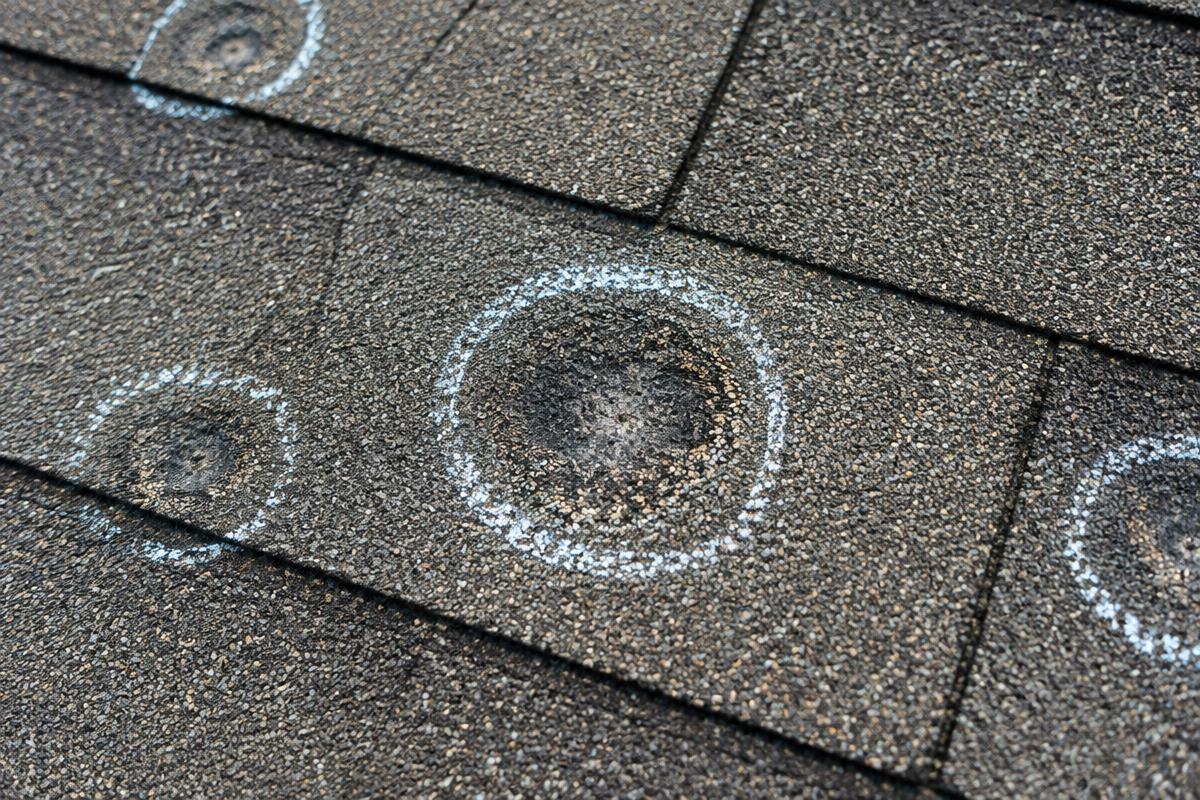
What you will see
Dings on gutters, downspouts, vents, cars, or siding. Granules in gutters. Dark spots on shingles.
Likely causes
Most cases trace back to one of these:
- Hail large enough to bruise shingle mats
- Wind-driven hail hitting one side of the roof harder
- Older shingles that were already brittle
How urgent is it?
Usually not an instant leak, but damage speeds up aging. Document soon, since insurers have reporting time limits.
Repair options
Depending on what the inspection finds:
- Replace scattered damaged shingles
- Replace damaged vents and flashing
- Full slope or full roof replacement if damage is widespread
When replacement is the smarter call
If most slopes show bruising, a full replacement usually makes more sense than many patches.
What an inspection should check
Hail damage is notoriously easy to miss from the ground since it rarely tears a hole in anything. A careful inspection should include:
- Soft metals first, gutters, downspouts, vents, and flashing, since they dent more visibly than shingles
- Shingle mats for bruising, a soft spot that feels different from surrounding granule-covered material
- Granule loss patterns in valleys and at downspout outlets
- Exposed mats or fiberglass where granules have been knocked completely off
- Soft spots found by gentle hand pressure across multiple slopes
- Skylights, pipe boots, and other penetrations for cracked or dented components
Temporary fix vs. permanent repair
There is usually no true temporary fix for hail bruising itself since the damage is internal to the shingle mat, not a visible hole. If hail also caused immediate leaks through cracked flashing or a punctured vent, a tarp or sealant can address the active leak while the fuller evaluation happens. The permanent fix for bruised shingles is replacement, either of the affected shingles or, if bruising is widespread, the full roof, since there is no way to repair a weakened shingle mat in place.
What happens if you wait
Hail bruising does not usually cause a leak the day it happens, which is exactly why it gets ignored. But a bruised shingle has a compromised mat that sheds granules faster and loses its weather resistance over time, which shortens the shingle's remaining life. Left unaddressed for a year or more, bruised areas can develop into active leaks, and documentation tying the damage to a specific storm becomes harder to establish the longer you wait.
What to do today
Check your gutters, downspouts, and any exterior AC unit or vehicle for dents, since visible dents on soft metal are a strong clue that hail was large enough to affect the roof too. Photograph any dented gutters, vents, or siding you can see safely from the ground. Avoid walking the roof yourself, both for safety and because walking on bruised shingles can cause additional damage. Schedule an inspection soon, since many insurers have reporting windows after a hail event.
What drives the cost of this repair
Cost depends on how many shingles are bruised, how widespread the pattern is across the roof's slopes, and whether damaged flashing, vents, or skylights also need replacing. A few scattered bruised shingles cost far less to address than a pattern covering most of the roof, which often points toward full replacement instead of spot repair. The roof repair cost guide and repair vs. replace comparison can help frame expectations before the roofer gives a specific scope.
How to describe it to the roofer
Mention the approximate date of the hailstorm and the hail size if you remember or saw local reports. Note which side of the house faced the storm, since wind-driven hail often hits harder on one slope. Share any photos of dented gutters, vents, or vehicles, since these help the roofer anticipate what they will find before climbing up.
Hail patterns in Central Illinois storms
Severe thunderstorms moving through the Decatur area can bring hail with little warning, and storm cells sometimes affect one side of town more than another. Because bruising is hard to self-diagnose, a dedicated hail damage roof repair evaluation or a storm roof inspection is usually more reliable than a visual check from the yard, and reviewing the roof insurance claim process ahead of time can help you know what documentation to gather.
What good workmanship looks like versus a rushed job
After a hail event, demand on local roofers can rise, which sometimes tempts a crew to move fast. Good workmanship includes a written record of which shingles or sections were replaced, matching ridge cap and flashing where it was disturbed, and a walkthrough explaining what was found and what was left alone. A rushed job might skip the walkthrough, replace only the most obvious spots while leaving scattered bruised shingles untouched, or fail to check soft metals like vents and gutter straps that also take hail impact.
Mistakes homeowners make after a hailstorm
A common mistake is waiting to see if a leak develops before calling anyone, which can push past an insurer's reporting window and make it harder to tie damage to a specific storm. Another is accepting a quick visual estimate without an actual hands-on check of the shingle mat, since bruising is often invisible without touch. Some homeowners also assume a single dented gutter means the whole roof is fine, when in fact gutters and roofing can be affected differently depending on angle and material. Comparing notes with the roof inspection checklist ahead of a visit can help you know what to expect. It is also worth asking how the roofer tells bruised shingles apart from ordinary wear, since the answer should involve hands-on checking rather than a quick glance from a ladder, and whether the assessment covers soft metals, skylights, and pipe boots in addition to the shingle field itself. Spring and early summer storm season in Central Illinois tends to bring the most hail activity, so homeowners in that stretch of the year may want to do a quick visual check of gutters and vents after any storm that produced marble-sized or larger hail nearby.
Common questions
Do dents on my car mean the roof is damaged?
Not always, but it is a good reason to get the roof checked.
Can hail damage a roof without leaving any visible marks?
Yes. Shingle bruising can be nearly invisible from the ground, which is why dented gutters and vents are often the first clue.
Does every hailstorm require a roof check?
Not necessarily small hail, but if you notice dented soft metals or hail large enough to dent vehicles, it is worth having the roof looked at.
How soon after hail should I schedule an inspection?
As soon as reasonably possible, since many insurance policies have time limits for reporting storm damage.
Will hail bruising get worse if I ignore it?
The bruise itself will not spread, but it accelerates granule loss and aging in that spot, which can lead to a leak over time.
Can I identify hail bruising by looking at my shingles from the ground?
Usually not. Bruising is typically felt as a soft spot up close rather than seen from a distance.
Is hail damage always covered by insurance?
It depends on your specific policy and deductible, so documentation and a professional assessment are important first steps.
Why would a roofer check my gutters if I only called about the shingles?
Dented gutters and vents are often the clearest visible sign of hail size, so checking them helps confirm whether the roof itself is likely affected.
If my neighbors got new roofs after a storm, does that mean mine needs one too?
Not necessarily. Roof age, slope, and material all affect how hail impacts a given roof, so each one should be assessed on its own.
Request a Hail Damage Roof Check
Describe it in the form and a local roofing partner will help you sort it out.