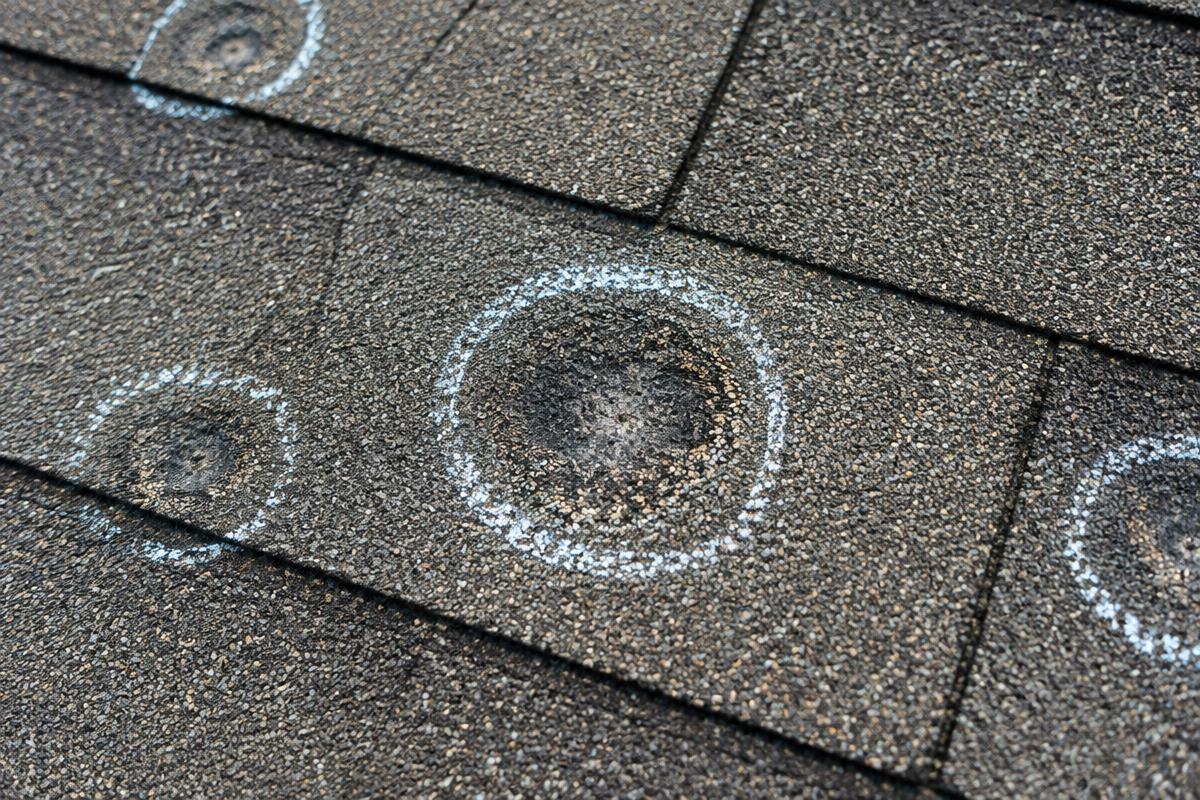
What inspectors look for
- Soft spots or bruises that feel like a bruised apple
- Circular granule loss exposing black mat
- Cracked or split shingles
- Dents on vents, flashing, and gutters as size clues
Repair or replace after hail
Scattered hits may be repairable. Widespread bruising across slopes usually means replacement, because damaged shingles age much faster.
How hail size relates to roof damage
Hail stones are not uniform, and the same storm can drop a mix of sizes across a neighborhood. Larger hail paired with wind tends to cause more consistent damage across a roof, while small hail may only dent soft metals without harming shingles. This is why dented gutters and vents are often used as a rough size reference during an inspection, even though they do not guarantee shingle damage on their own.
What an inspection checks beyond the shingles
A thorough hail inspection looks past the obvious roofing surface.
- Soft metals like gutters, downspouts, and vent caps for dimpling
- Pipe boots and flashing edges for cracking or granule loss
- Skylight frames and curbs if the home has them
- Attic decking for signs that water already found a path inside
- Ridge caps and hips, which take direct impact on sloped roofs
Granule loss and why it matters
Granules are the protective layer on asphalt shingles that shields the underlying mat from UV and weather. Hail impacts knock granules loose in a circular pattern, exposing the black mat underneath. A shingle with exposed mat wears faster and is more likely to crack, so patchy granule loss across many shingles is treated differently than a few scattered marks.
Soft metal damage as a clue, not a verdict
Dents on gutters, vents, or flashing tell an inspector roughly how much force the storm delivered, but soft metal and shingles react to hail differently. A dented gutter does not automatically mean the shingles were damaged, and undamaged gutters do not rule out shingle bruising either. That is why both are checked rather than one standing in for the other.
Process from inspection to finished repair
After the initial inspection and documentation, you will see the findings explained in plain terms, review repair or replacement options, and get a written estimate before anything is scheduled. Many homeowners choose to move straight from findings into scheduling, but there is no requirement to decide on the spot.
When repair is enough versus when replacement makes sense
A handful of isolated hail hits in a small area can often be repaired by replacing individual shingles. Damage spread across most of the roof, especially combined with age or prior wear, usually points toward full replacement since patched sections rarely match surrounding shingles for long. More on that tradeoff is covered under repair versus replace and storm damage repair in general.
Documentation that supports any next steps
Clear photos of bruised shingles, granule loss, and metal dimpling, taken slope by slope, make it much easier to explain what happened to your roof regardless of what you decide to do next. See storm roof inspection for how that documentation is typically organized.
Cost drivers for a hail repair
Several factors shape the scope and effort of a hail repair without assuming any specific price.
- How many shingles show bruising versus scattered cosmetic marks
- Whether gutters, vents, or flashing also need replacing
- Roof pitch, height, and access for the crew
- Whether a matching shingle color and style is still available
- Whether soft metals like vents and downspouts need replacing alongside the roof surface
Hail damage on metal roofing versus shingles
Metal roofing generally resists hail better than asphalt shingles, but it is not immune. Exposed fastener panels and standing seam panels can both dent from large hail, and heavy dimpling can affect a panel's finish and long-term durability even without a hole or leak. See metal roofing and standing seam metal roofing for more on how those systems are inspected and repaired after impact damage.
Why hail damage is easy to underestimate from the ground
From the yard, a hail-damaged roof can look almost normal. Bruises are often not visible without walking the slopes or testing suspect areas up close, and granule loss can be subtle until it has progressed. This gap between what is visible and what is actually happening is the main reason hail damage goes unaddressed longer than wind or missing-shingle damage, which tend to be easier to spot.
Hail damage on commercial and flat roofing
Flat and low-slope commercial roofs can also take hail impact, sometimes showing as bruising, cracking, or granule loss on modified bitumen and roof coatings, or scattered impact marks on TPO and EPDM membranes. See modified bitumen, TPO roofing, and EPDM roofing for how those membrane types are checked after a hailstorm, since the inspection approach differs from a sloped shingle roof.
Why documentation timing matters
Granule loss and hairline mat cracking can be harder to photograph clearly as shingles continue to weather after the storm. Getting a storm roof inspection scheduled reasonably soon after a hail event, rather than waiting through several more rain cycles, generally produces clearer documentation of what the hail itself caused.
What a roofer explains during the findings review
After the inspection, expect a plain explanation of what was found on each slope, which areas show clear hail impact versus normal wear, and how that translates into repair or replacement options. This is also the point to ask questions about why a particular area is being flagged, since impact marks can sometimes be subtle enough to need a side-by-side comparison with undamaged shingles nearby.
Common questions
Does small hail matter?
Pea-size hail rarely harms newer shingles. Larger hail, or hail with strong wind, is more likely to cause damage.
Can hail damage shingles without leaving visible dents?
Yes. Bruising can crack the mat beneath the surface without an obvious dent, which is why a close inspection matters more than a quick glance.
Does hail damage look the same on every roof slope?
No. Wind during the storm usually pushes hail at an angle, so slopes facing the storm's direction often show more impact than sheltered slopes.
How is hail damage different from normal shingle wear?
Normal wear is gradual and spread evenly across the roof. Hail damage tends to appear as scattered, circular impact marks concentrated after one event.
Can metal roofing be damaged by hail too?
Yes, standing seam and exposed fastener metal panels can dent from large hail, though metal generally resists hail better than asphalt shingles.
Is a few months' delay after hail a problem?
It can be. Exposed mat from granule loss ages faster in sun and rain, so damage that was minor at first can worsen over a season or two.
Do skylights need separate inspection after hail?
Yes. Skylight frames and seals can crack from hail impact even when the surrounding shingles look fine, so they are checked separately.
Can hail damage be confused with manufacturing defects?
Sometimes. Blistering or granule loss from age or a defective batch can resemble hail wear, which is one reason an inspector looks at patterns across the whole roof rather than a single shingle.
Does the direction a slope faces matter for hail inspections?
Yes. Slopes that faced into the storm typically take more direct hits, while sheltered sides and areas under overhangs may show far less impact.
Get a Roof Inspection After Hail
Describe it in the form and a local roofing partner will help you sort it out.