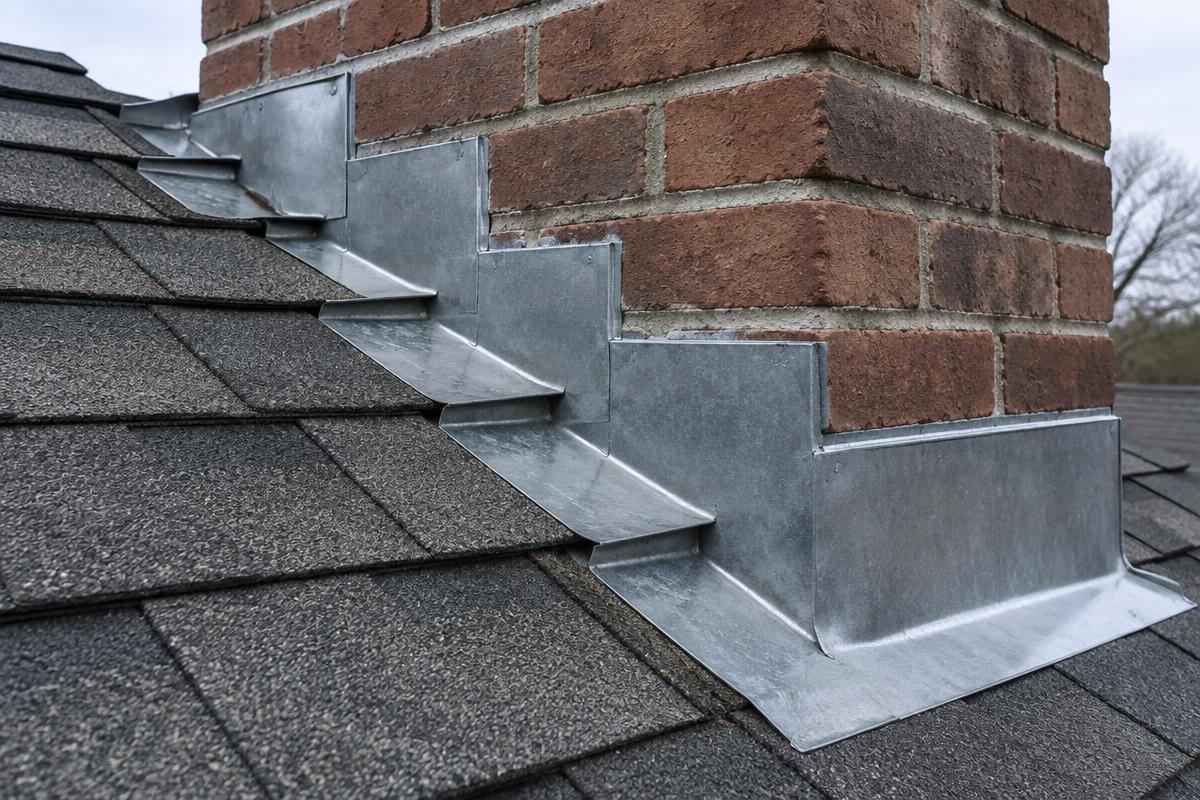
What you will see
Stains on the ceiling or wall beside the chimney, damp smell, rusty damper, or water in the firebox.
Likely causes
Most cases trace back to one of these:
- Flashing sealed only with tar
- Counter-flashing loose from mortar
- Cracked chimney crown
- Missing cap letting rain in
- No cricket behind a wide chimney
How urgent is it?
Moderate. Ongoing leaks rot framing next to the chimney, which is costly to reach later.
Repair options
Depending on what the inspection finds:
- New step and counter-flashing
- Add a cricket
- Repair crown and add a cap
- Seal porous brick
When replacement is the smarter call
If the roof is being replaced soon, re-flash the chimney during that job so it ties in properly.
What an inspection should check
Chimney leaks often come from a gap that is easy to overlook unless someone checks each layer of flashing deliberately. A thorough inspection should cover:
- Step flashing along the sides of the chimney for gaps or missing pieces
- Counter-flashing or the cap on top of the step flashing for separation from the brick
- The chimney cricket or saddle, if present, for proper water diversion on wider chimneys
- Mortar joints and brick condition, since cracked masonry can let water in separately from the flashing
- Sealant or caulk at flashing edges for cracking or drying out
- The attic area around the chimney chase for staining or wet insulation
Temporary fix vs. permanent repair
A bead of roofing sealant over an obvious gap can slow a leak temporarily, but sealant alone breaks down with UV exposure and temperature swings, so it should never be treated as the final answer. The permanent repair usually means re-flashing the chimney with properly layered step and counter-flashing so water sheds correctly instead of relying on caulk to bridge a gap. If the chimney or surrounding roof area has multiple issues, it is worth discussing both roof repair and whether the chimney flashing should be redone as part of a future roof replacement.
What happens if you wait
Chimney leaks tend to be slow and intermittent, which makes them easy to put off, but the moisture usually tracks down into the attic framing near the chase and can spread along ceiling joists before it ever shows up as a visible stain. Left long enough, it can rot the decking around the chimney and damage interior ceilings or walls near the fireplace. Because chimney flashing failures rarely fix themselves, waiting generally just adds to the area that eventually needs repair.
What to do today
Check the attic near the chimney chase for any staining, dampness, or a musty smell, using a flashlight rather than climbing into tight spaces unnecessarily. Note whether the leak seems to track with rain direction or wind. Do not attempt to re-caulk the flashing yourself from a ladder, since proper flashing work requires removing and layering materials correctly, not just adding sealant. Schedule an inspection so the roofer can trace the leak path before it causes more interior damage.
What drives the cost of this repair
Cost depends on how much of the flashing needs replacing, whether the chimney has a cricket that also needs attention, chimney size and roof pitch for access, and whether any masonry repair is needed alongside the flashing work. A straightforward re-flash on an easily accessible chimney costs less than one requiring scaffolding or masonry repair. The roof repair cost guide offers general context, and how roofing estimates work explains what typically goes into a written scope.
How to describe it to the roofer
Tell the roofer where inside the house you notice staining or dampness relative to the chimney's location, and whether the leak appears during rain, snowmelt, or both. Mention if you have ever had chimney or flashing work done before, and whether the chimney is brick, block, or a metal prefabricated unit, since the flashing approach differs between types.
Freeze-thaw stress on Central Illinois chimneys
Decatur winters bring repeated freeze-thaw cycles that can work flashing loose over several seasons, even if it was sealed well originally. Temperature swings also stress the mortar joints that flashing relies on for a tight seal against the brick. If a chimney leak seems to appear only in certain weather, it is worth mentioning that pattern, and emergency roof repair is available if the leak becomes active during a storm.
A step-by-step checklist before the roofer arrives
A little preparation helps the visit go faster and gives the roofer better information to work with.
- Check the attic near the chimney chase with a flashlight for staining, dampness, or a musty smell
- Note the date and weather conditions when you first noticed the leak
- Look at ceilings and walls near the fireplace for discoloration, even faint
- Check whether the chimney is brick, block, or a metal prefabricated unit
- Take photos of any visible gaps or rust around the chimney base from a safe ground-level vantage point
- List any prior chimney, roof, or masonry work done on the house, even if it seems unrelated
How a chimney leak connects to the rest of the roof
Chimney flashing rarely fails in isolation. The same freeze-thaw stress and wind exposure that loosens flashing can also affect nearby valleys, nail patterns, and shingle seals, so a roofer looking at the chimney will often glance at the surrounding roof plane as well. If the chimney sits near a valley, it is worth asking whether valley leaks could be contributing to what looks like a chimney-only issue, since water traveling down a valley can sometimes show up as staining near the chimney chase instead. Ridge vents and roof penetrations located close to a chimney can also share the same freeze-thaw stress, so if more than one trouble spot shows up during the inspection, ask whether addressing them together makes more sense than scheduling separate visits later.
Common questions
Is tar on the chimney a problem?
Thick tar usually means someone patched a leak instead of fixing the flashing.
Is it the chimney or the roof leaking?
Chimney flashing leaks often look like roof leaks because the water travels before it shows up on the ceiling, so an inspection is the best way to tell them apart.
Can I just caulk around my chimney myself?
Caulk alone does not replace proper flashing layers and tends to fail again within a season or two, so it is best treated as a short-term measure only.
Does chimney flashing need to be replaced every time the roof is replaced?
Not always, but it is common practice to redo flashing during a roof replacement since it is already exposed.
Why does my chimney leak only sometimes?
Wind-driven rain, freeze-thaw movement, or snowmelt can all cause intermittent leaking depending on conditions.
Could the leak actually be coming from the chimney cap or crown instead of the roof flashing?
Yes, a cracked chimney crown or missing cap can also let water in, which is why the whole chimney area should be checked, not just the flashing.
Will a chimney leak show up right away after a storm?
Not necessarily. Water can take time to travel through the chase and framing before reaching a visible ceiling area.
Do I need to be home for the whole chimney flashing inspection?
Being available to point out interior staining and answer questions is helpful, but the roofer will spend most of the time on the roof and in the attic.
Can an old chimney cricket cause the same symptoms as a flashing leak?
Yes, a missing or undersized cricket on a wider chimney can let water pool and find its way in much like a flashing gap would.
Get Chimney Flashing Checked Today
Describe it in the form and a local roofing partner will help you sort it out.